When you search on Google, you get a list of links ranked by relevance. When you ask ChatGPT or Perplexity the same question, you get a written answer that reads like a knowledgeable friend explaining something to you. The experience feels completely different, and that is because the technology behind it is fundamentally different.
Understanding how AI search engines work is essential for anyone trying to optimize their content for these platforms. You cannot effectively optimize for a system you do not understand. This guide explains the mechanics behind AI-powered search, how it differs from traditional search, and what it means for your content strategy.
If you are familiar with how traditional search engines crawl, index, and rank content, think of this as the next chapter in that story.
Traditional Search vs. AI Search: A Fundamental Shift
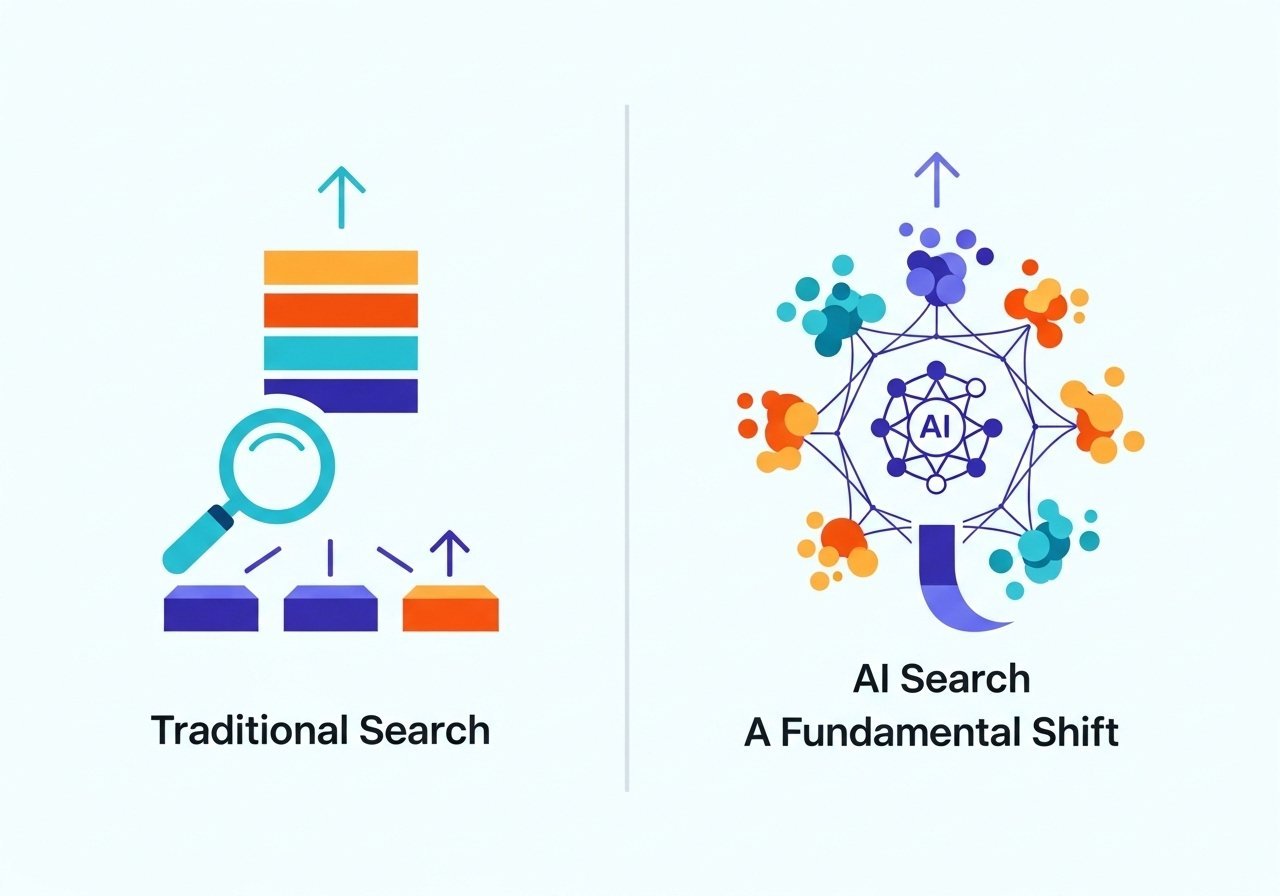
Traditional search engines like Google follow a three-step process: they crawl the web to discover pages, index those pages in a database, and rank them based on relevance signals when someone searches. The output is a list of links, and the user decides which one to click.
AI search engines follow a different path. They still rely on web content as their information source, but the way they process and present that information is entirely new.
When you ask an AI platform a question, it goes through several steps:
- Query interpretation: The AI analyzes your full question, understanding context, intent, and nuance. Unlike Google’s keyword matching, AI processes natural language at a much deeper level. The average AI query is 23 words, compared to Google’s 4-word average
- Information retrieval: The AI identifies relevant sources from its training data, live web searches, or both. Different platforms handle this differently, which we will cover below
- Synthesis: Instead of showing you a list of sources, the AI reads, combines, and rewrites information from multiple sources into a single, coherent response
- Citation (sometimes): Some platforms, like Perplexity, cite their sources with clickable links. Others, like ChatGPT, may mention sources without linking, or generate responses without explicit attribution
This synthesis step is what makes AI search fundamentally different. The AI is not pointing you to content. It is consuming content and creating something new from it. Your goal in generative engine optimization is to be one of the sources it consumes and credits.
How Different AI Platforms Process Content
Not all AI search engines work the same way. Each platform has its own approach to finding, evaluating, and referencing content. Understanding these differences helps you tailor your optimization for each one.
ChatGPT operates in two modes. It has a massive knowledge base from its training data (information it learned during training, up to a knowledge cutoff date). It also has a “Browse with Bing” feature that performs live web searches for current queries. ChatGPT tends to favor content from high-authority, well-established sources that were part of its training data. For newer content, it relies on Bing’s search index. Getting cited by ChatGPT requires building authority across the web, not just on your own site.
Perplexity is built as an “answer engine” from the ground up. It performs real-time web searches for every query, retrieving and citing live sources. Perplexity is the most citation-heavy AI platform, often referencing 4 to 16 sources per response with clickable links. This makes it the most SEO-friendly AI search engine. Ranking on Perplexity rewards many of the same things traditional SEO does: fresh content, clear structure, and domain authority.
Google AI Overviews are powered by Google’s own index and Gemini model. They appear directly in Google’s search results, above the traditional organic listings. Because they use Google’s existing index, the content that ranks well in traditional search also has a strong advantage in AI Overviews. Our guide on optimizing for Google AI Overviews covers the specific tactics.
Claude (made by Anthropic) has more limited search capabilities compared to ChatGPT and Perplexity, but its growing user base, particularly among technical and research-focused audiences, makes it worth considering. Claude’s citation behavior is less transparent, so optimization here relies more on being part of high-authority sources.
What AI Engines Look for in Content
Across all platforms, AI search engines evaluate content based on several shared principles. These are the factors that determine whether your content gets selected as a source:
Clarity and structure. AI systems extract individual paragraphs and sections, not whole pages. Content with clear headings, short paragraphs, and self-contained answers is much easier for AI to process. This is why content structure for AI citations is a core GEO skill.
Factual accuracy and evidence. AI systems favor content that includes statistics, data points, research citations, and expert quotes. The Princeton study on GEO found that adding statistics and citations improved AI visibility by 30 to 40 percent. Original research and data is one of the most powerful ways to earn AI citations.
Authority and trust. AI engines assess not just your content but your site’s overall reputation. Factors like E-E-A-T signals, backlink profiles, and brand mentions across the web all influence whether an AI considers you a trustworthy source.
Recency. AI platforms weight recent content more heavily, especially for topics that change over time. A regularly updated piece of content will outperform a stale article on the same subject.
Comprehensiveness. AI prefers sources that cover a topic thoroughly. Building topic clusters for GEO signals to AI engines that your site has deep, interconnected expertise on a subject.
The Role of Training Data vs. Live Search
One important distinction is whether an AI platform uses its training data, live web searches, or a combination of both.
Training data is the information the AI learned during its initial training process. This data has a cutoff date and does not include recent events or newly published content. AI platforms that rely heavily on training data (like ChatGPT for many queries) tend to favor established, well-known sources that were already prominent at the time of training.
Live search (also called retrieval-augmented generation, or RAG) is when the AI performs a real-time web search to find current information before generating its response. Perplexity uses this approach for every query. ChatGPT uses it when browsing is enabled. Google AI Overviews use Google’s live index.
For GEO, this means two things:
- For platforms that use training data, building long-term brand authority and being cited on high-profile sites is critical
- For platforms that use live search, many traditional SEO practices (fresh content, strong indexing, fast page speed) directly support your AI visibility
Understand the Machine, Then Optimize for It
AI search engines are not magical black boxes. They are systems that retrieve, evaluate, and synthesize information based on specific criteria. Understanding those criteria gives you a clear roadmap for optimization.
The platforms differ in their details, but the fundamentals are consistent: create clear, well-structured, evidence-rich content on a technically sound website, and build your authority across the web. That formula works across ChatGPT, Perplexity, Google AI Overviews, and whatever new platform emerges next.
Now that you understand how these systems work, the next step is understanding what it means for your brand. Our guide on AI search visibility explains why being visible in AI answers matters and how to start measuring your presence across these platforms.