
You could write the most insightful, well-researched article on the internet, but if it is structured as one long wall of text, AI search engines will struggle to use it. The way you format and organize your content directly determines whether AI platforms can extract, cite, and reference your work in their responses.
Content structure for AI citations is not about making your writing look pretty. It is about making it machine-readable. AI systems like ChatGPT, Perplexity, and Google AI Overviews do not read entire pages the way humans do. They scan for specific sections, evaluate individual paragraphs, and pull discrete chunks of information. If your content is organized in a way that makes extraction easy, you win more citations.
This is one of the most practical skills in generative engine optimization. It costs nothing, requires no special tools, and can be applied to every piece of content you create starting today.
The Self-Contained Section Principle
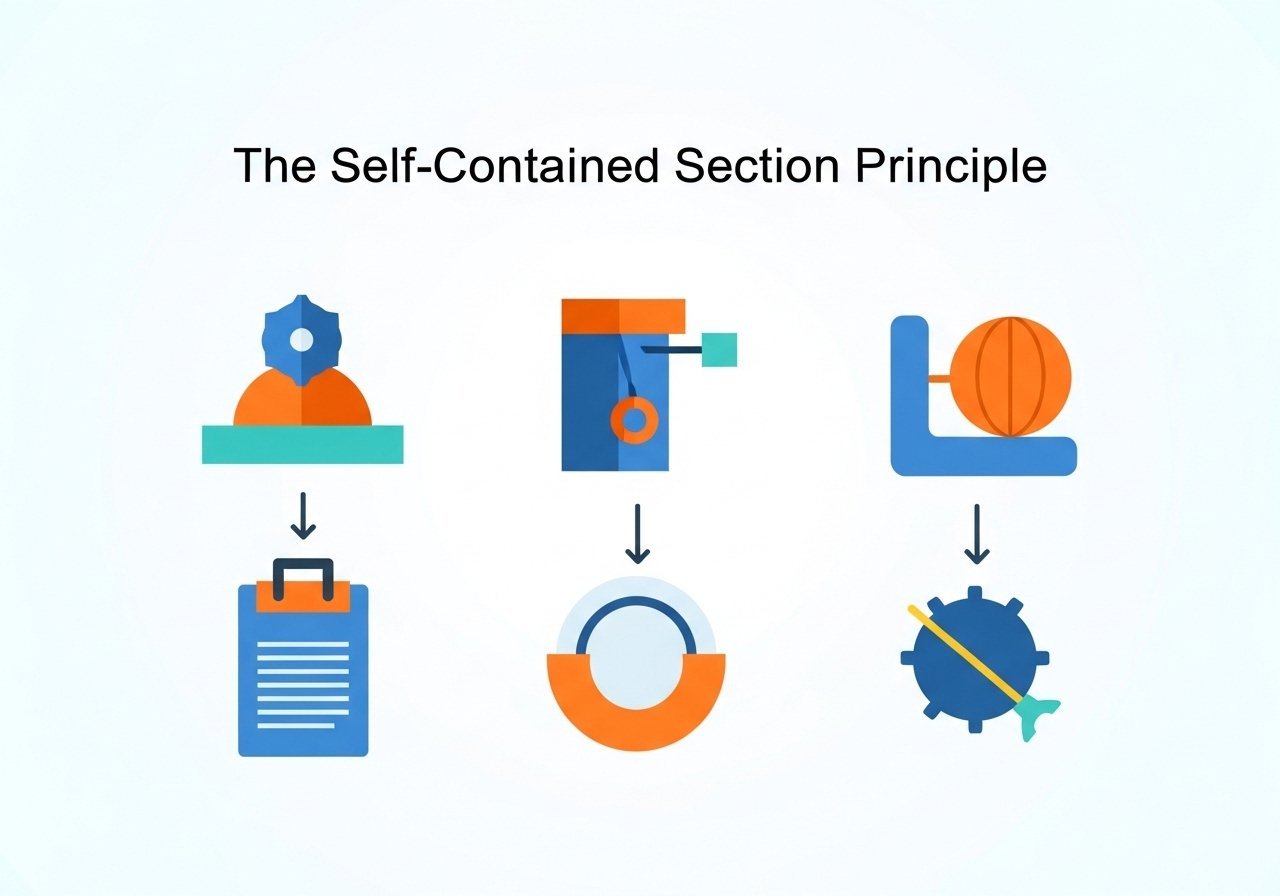
The most important rule of AI-friendly content structure is this: every section should be able to stand on its own as a complete, useful answer.
In traditional blog writing, sections often depend on each other. You might introduce a concept in section one, reference it in section two, and draw conclusions in section three. That narrative flow works beautifully for human readers, but AI systems do not process content linearly. They grab individual sections and use them independently.
Here is what a self-contained section looks like:
- The H2 or H3 heading clearly labels what the section covers (ideally in question format)
- The first sentence directly answers the question or defines the topic
- The following sentences add context, evidence, or examples
- The section makes sense even if someone reads it without any other part of the article
- No references to “as we discussed above” or “as mentioned earlier”
Think of each section as a mini-article within your article. This approach also improves readability for human visitors who scan content, which aligns with good SEO content writing practices.
Question-Based Headings That Match AI Queries
When someone asks Perplexity “how does schema markup help with AI search?” the platform scans the web for pages that address that exact question. If your H2 heading says “How Does Schema Markup Help with AI Search?” followed by a direct answer, you have created a perfect match between the user’s query and your content.
This is why question-based headings are so powerful for GEO. They create a direct alignment between what people ask AI platforms and what your content provides.
Guidelines for effective headings:
- Use “How,” “What,” “Why,” “When,” and “Which” to start headings where appropriate
- Match the natural language people use when talking to AI. “What Is the Best Way to Track AI Traffic?” is better than “AI Traffic Tracking Methods”
- Be specific rather than vague. “How to Get Cited by Perplexity AI” is better than “Getting AI Citations”
- Keep headings under 70 characters for clean extraction
You do not need to make every heading a question. A mix of question headings and clear topic labels works well. The key is that each heading tells both humans and AI exactly what the section covers.
The Answer-First Paragraph Pattern
After each heading, the first paragraph should deliver the core answer or key point immediately. This is the paragraph that AI systems are most likely to extract and cite.
Here is the pattern:
First sentence: Direct answer to the heading’s question or a clear statement of the key point.
Second and third sentences: Supporting context, a brief explanation of why this matters, or a qualifying detail.
Fourth sentence (optional): A transition to the deeper explanation that follows.
For example, under a heading like “How Many Words Should an AI-Optimized Article Be?” the first paragraph should not start with background about content length debates. It should start with: “For AI search optimization, articles between 1,500 and 2,500 words tend to perform best across ChatGPT, Perplexity, and Google AI Overviews.”
This pattern is identical to what works for featured snippet optimization. Google’s featured snippets extract the paragraph right below the heading, and AI platforms do the same thing.
Lists, Tables, and Structured Formats
AI platforms love structured data within content. When your information is organized into lists, tables, or clearly formatted comparisons, it becomes significantly easier for AI to extract and present.
Bullet and numbered lists are extracted frequently by all major AI platforms. Use them whenever you present multiple items, steps, or factors. Keep each item substantive (one to two sentences, not just a few words).
HTML tables are particularly effective for comparison content. When someone asks an AI “what is the difference between GEO and SEO?” a well-structured comparison table gives the AI a clean format to reference. Tables work especially well for Google AI Overviews.
Definition formatting using bold terms followed by explanations helps AI identify and extract specific concepts. The pattern of “Term: followed by explanation” is clean enough for AI to pull directly into a response.
FAQ Sections as Citation Magnets
Adding a well-structured FAQ section at the end of your article is one of the easiest ways to earn AI citations. Each question-and-answer pair is a perfectly self-contained unit of information that AI systems can extract cleanly.
Effective FAQ sections for GEO:
- Include 3 to 5 questions that your target audience actually asks (pull these from prompt-based keyword research)
- Keep answers concise: 2 to 4 sentences per answer
- Answer the question completely in those few sentences without requiring additional context
- Add FAQ schema markup so AI platforms can identify the Q&A structure programmatically
Our dedicated guide on FAQ content strategy for GEO goes deeper into building FAQ sections that maximize AI citations.
Putting It All Together
Here is the ideal structure template for an AI-optimized article:
- Introduction: Hook the reader, state the main topic, include primary keyword in first paragraph. Link to pillar page.
- H2 sections (3 to 5): Each with a question-based or clear topic heading, answer-first opening paragraph, supporting detail, and relevant internal links
- H3 subsections: Where needed for depth, following the same self-contained principle
- Lists and tables: Used wherever multiple items, comparisons, or steps are involved
- Conclusion: Summary of key points with call to action and internal links to related content
- FAQ section: 3 to 5 question-and-answer pairs with schema markup
This structure serves three audiences simultaneously: human readers who scan for relevant sections, traditional search engines that evaluate heading structure and keyword placement, and AI platforms that extract individual sections for citation.
Ready to add the technical layer that helps AI understand your content even better? Our guide on schema markup for GEO shows you how to use structured data to give AI platforms explicit signals about what your content contains.