Traditional keyword research has served us well for twenty years. You find a keyword, check the search volume, assess the competition, and create content around it. But AI search has introduced a new type of query that traditional keyword tools were not designed to capture.
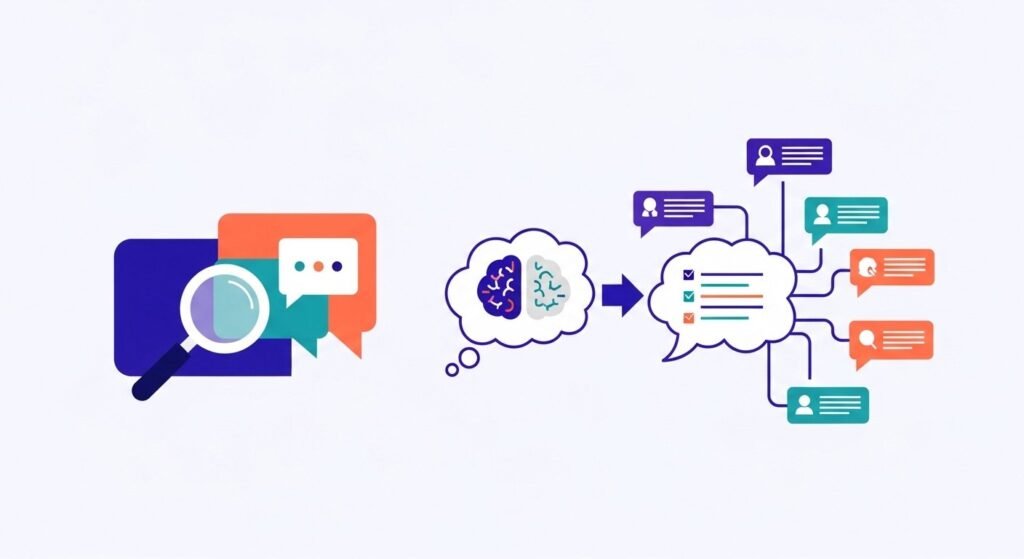
When people search on ChatGPT, Perplexity, or Google with AI Overviews, they do not type three-word phrases. They write full sentences and even paragraphs. The average AI search query is 23 words long, compared to Google’s traditional average of just 4 words. These are not keywords. They are prompts. And understanding them is the key to creating content that AI search engines want to cite.
Prompt-based keyword research is the practice of identifying, analyzing, and targeting the conversational questions your audience asks AI platforms. It builds on everything you know about traditional keyword research but adds a new layer of depth and specificity.
Why Traditional Keywords Are Not Enough for GEO
A traditional keyword like “best SEO tools” tells you that someone wants a list of SEO tools. That is useful, but it is vague. In AI search, the same person might ask:
“I run a small digital marketing agency with 5 clients. What are the most affordable SEO tools that can handle multiple projects, have good reporting features for clients, and are easy for my team to learn?”
That prompt contains far more context: business type, team size, budget sensitivity, specific feature needs, and skill level. The content that answers this specific scenario is far more likely to be cited than a generic “10 best SEO tools” listicle.
This is the fundamental shift prompt-based keyword research addresses. You are moving from targeting broad phrases to understanding and answering specific, context-rich questions.
How to Find the Prompts Your Audience Uses
Since AI platforms do not publish search query data the way Google does through Search Console, finding prompts requires a different research approach.
Ask AI platforms directly. One of the most effective methods is to ask ChatGPT or Perplexity: “What are the most common questions people ask about [your topic]?” The responses often reveal the exact conversational formats people use.
Mine Google’s “People Also Ask” boxes. These question clusters already represent the conversational queries people have about a topic. They are essentially prompts waiting to happen. Our featured snippets guide explains how to use PAA for content planning.
Analyze long-tail queries in Search Console. Filter your Search Console data for queries longer than 6 words. These longer queries are closer to the conversational format people use with AI platforms.
Study Reddit and forum questions. The questions people ask on Reddit, Quora, and niche forums are often identical to the prompts they type into AI search tools. These platforms reveal the natural language people use when seeking help.
Use AI to generate prompt variations. Enter your seed topic into ChatGPT and ask it to generate 20 different ways someone might ask about that topic. This reveals the range of prompt formats and scenarios your audience might use.
Turning Prompts into Content
Once you have a list of prompts, the next step is creating content that addresses them. This is where prompt-based research connects back to your content optimization strategy.
Create use-case-specific sections. Instead of one generic answer, create sections that address different user scenarios. For example, if your article is about SEO tools, include sections like “Best SEO Tools for Solo Bloggers,” “Best SEO Tools for Agencies,” and “Best SEO Tools for E-commerce.”
Write comparison content that matches prompt patterns. People frequently ask AI tools to compare options: “Which is better, Ahrefs or SEMrush, for a beginner?” Create content that directly compares the options people ask about, with clear recommendations based on specific criteria.
Address the “for whom” and “under what conditions” dimensions. Generic content answers the “what.” Prompt-optimized content also answers the “for whom” and “when.” A section titled “When Should You Use This Strategy?” is more citable than one titled “Strategy Overview.”
Build FAQ sections from real prompts. Take the most common prompts you discover and turn them into a FAQ section at the end of your article. Format each question exactly as someone would type it into ChatGPT, then provide a concise, factual answer.
Mapping Prompts to Your Content Funnel
Just like traditional search intent, prompts fall into different stages of the buyer’s journey:
- Awareness prompts: “What is generative engine optimization and should I care about it?” These map to educational, introductory content
- Consideration prompts: “What are the best GEO strategies for a small business blog with limited budget?” These map to strategic, how-to content
- Decision prompts: “Compare Semrush AI toolkit vs Ahrefs for GEO tracking, which is better value?” These map to comparison and review content
Mapping prompts across all three stages ensures you have content that can be cited no matter where the user is in their journey. This is also how you build topic clusters for GEO that cover a subject comprehensively enough for AI platforms to treat you as an authoritative source.
Prompt Research Is Ongoing
Unlike traditional keywords, which tend to be stable over time, the prompts people use evolve as they become more comfortable with AI tools. Six months ago, people asked simple questions. Today, many users write multi-paragraph prompts with specific context and constraints.
Make prompt research a monthly habit. Run your key topics through AI platforms, check what questions people are asking, and update your content to address new prompt patterns as they emerge.
The sites that stay ahead of this evolution are the ones that build a content library specifically designed for how people actually talk to AI, not just how they type into a search box.
Next, learn the specific formatting techniques that make your content irresistible to AI citation systems. Our guide on content structure for AI citations covers the exact HTML patterns, heading formats, and section layouts that work best across all AI platforms.