
Schema markup has been a valuable SEO tactic for years. It helps Google display rich results, understand your content better, and connect your pages to its knowledge graph. But in the context of generative engine optimization, schema takes on an even more important role. It gives AI search engines explicit, machine-readable signals about what your content is, who wrote it, and what questions it answers.
If you are already familiar with structured data basics from our SEO cluster, this guide builds on that foundation with GEO-specific applications. If you are new to schema entirely, that article covers the fundamentals you should understand first.
Why Schema Matters More for GEO Than for Traditional SEO
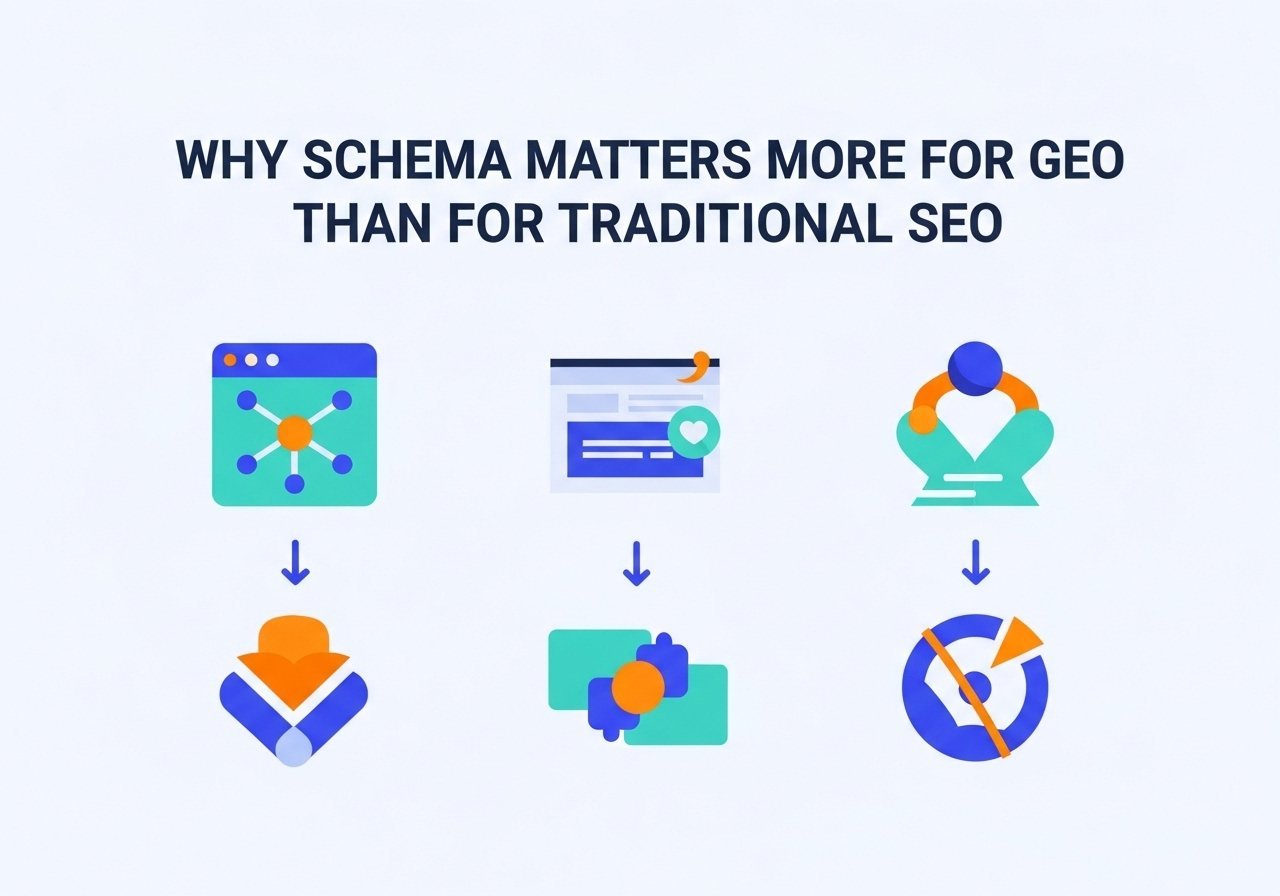
In traditional SEO, schema markup is a “nice to have.” It can earn you rich results in Google (star ratings, FAQ dropdowns, how-to steps), but your pages can rank perfectly well without it.
In GEO, schema moves closer to a “must have.” Here is why:
AI search engines process enormous amounts of content to generate responses. Anything that helps them quickly understand what a page contains and how reliable it is gives that page an advantage. Schema markup is literally a standardized language for communicating this information to machines.
When an AI engine encounters a page with Article schema, it instantly knows the headline, author, publish date, and content type. When it finds FAQ schema, it knows exactly which questions are answered and what the answers are. When it sees Author/Person schema, it can evaluate the expertise of the content creator.
Without schema, the AI has to figure all of this out by parsing the HTML, which is less reliable and more error-prone. Pages with clean schema reduce the AI’s uncertainty and increase the likelihood of being cited.
The Most Important Schema Types for GEO
Not all schema types carry equal weight for AI visibility. Here are the ones that matter most:
Article schema should be on every blog post. It communicates the headline, author name, publish date, last modified date, and featured image. This is the baseline that establishes your content as a legitimate, attributable piece of writing.
FAQ schema is arguably the single most impactful schema type for GEO. It marks up question-and-answer pairs in a format that AI engines can extract directly. When someone asks ChatGPT a question and your page has that exact question in FAQ schema with a clear answer, the match is perfect. Combine this with the FAQ content strategy we cover separately.
How-To schema structures step-by-step instructions with named steps, tools required, and estimated time. This is especially valuable for instructional content, which is frequently cited by AI platforms.
Author/Person schema connects your content to a specific person with credentials, affiliations, and expertise. This directly supports E-E-A-T signals that both Google and AI engines use to evaluate credibility.
Organization schema establishes your brand’s identity, including name, logo, contact information, and social profiles. This helps AI engines connect your website to your broader brand presence across the web.
Breadcrumb schema shows your site’s navigation hierarchy, helping AI understand how your content is organized and where each page fits within your topic clusters.
How to Implement Schema for GEO
If you are using WordPress with Rank Math or Yoast SEO, most of this is handled through the plugin’s settings. Here is what to check and configure:
Article schema (automatic): Both Rank Math and Yoast automatically add Article schema to blog posts. Verify it is working by testing any post URL in Google’s Rich Results Test.
FAQ schema (manual per post): In Rank Math, you can add FAQ blocks directly in the editor. In Yoast, use the FAQ Structured Data block. Add 3 to 5 question-and-answer pairs at the end of each article.
Author schema: Make sure your WordPress author profile is fully filled out: real name, bio, profile photo, and links to social accounts. Rank Math can generate Person schema from this data. Create a dedicated author page that lists your expertise and credentials.
Organization schema: Configure this once in your SEO plugin’s global settings. Include your brand name, logo, and social media profiles.
For more advanced implementations, JSON-LD (JavaScript Object Notation for Linked Data) is the recommended format. It is added as a script block in your page’s HTML and does not interfere with visible content.
Schema Validation and Testing
After implementing schema, always validate it. Errors in your markup can cause AI engines to ignore it entirely.
- Google Rich Results Test: Shows whether your page is eligible for rich results and flags schema errors
- Schema Markup Validator: Checks the technical correctness of your structured data against the Schema.org vocabulary
- Google Search Console: The Enhancements section reports on structured data across your entire site, grouped by type
Common schema mistakes to avoid:
- Adding FAQ schema for questions that are not actually answered in your visible content
- Using outdated or incomplete author information
- Missing required fields (like datePublished for Article schema)
- Duplicate or conflicting schema from multiple plugins
Schema as Part of Your Broader GEO Strategy
Schema markup alone will not make your content appear in AI responses. It works as an amplifier for content that is already well-written, well-structured, and authoritative. Think of it as removing friction: you are making it as easy as possible for AI engines to understand and trust your content.
Combined with strong content structure, AI-optimized writing, and genuine AI search visibility building, schema markup completes the technical foundation that gives your content the best possible chance of being cited across all AI platforms.
Next, learn about another technical factor that directly affects whether AI engines can even access your content. Our guide on making your website AI-crawlable covers the accessibility requirements that many sites are unknowingly failing.