
In traditional SEO, you measure success by rankings and organic traffic. In PPC, you measure impression share and cost per click. But in generative engine optimization, the key metric is something different: share of voice in AI search.
Share of voice (also called “share of model” in some GEO frameworks) measures how often your brand appears in AI-generated responses compared to your competitors for relevant queries. It is the GEO equivalent of market share, and it is quickly becoming the most important metric for understanding your brand’s visibility in AI-driven search.
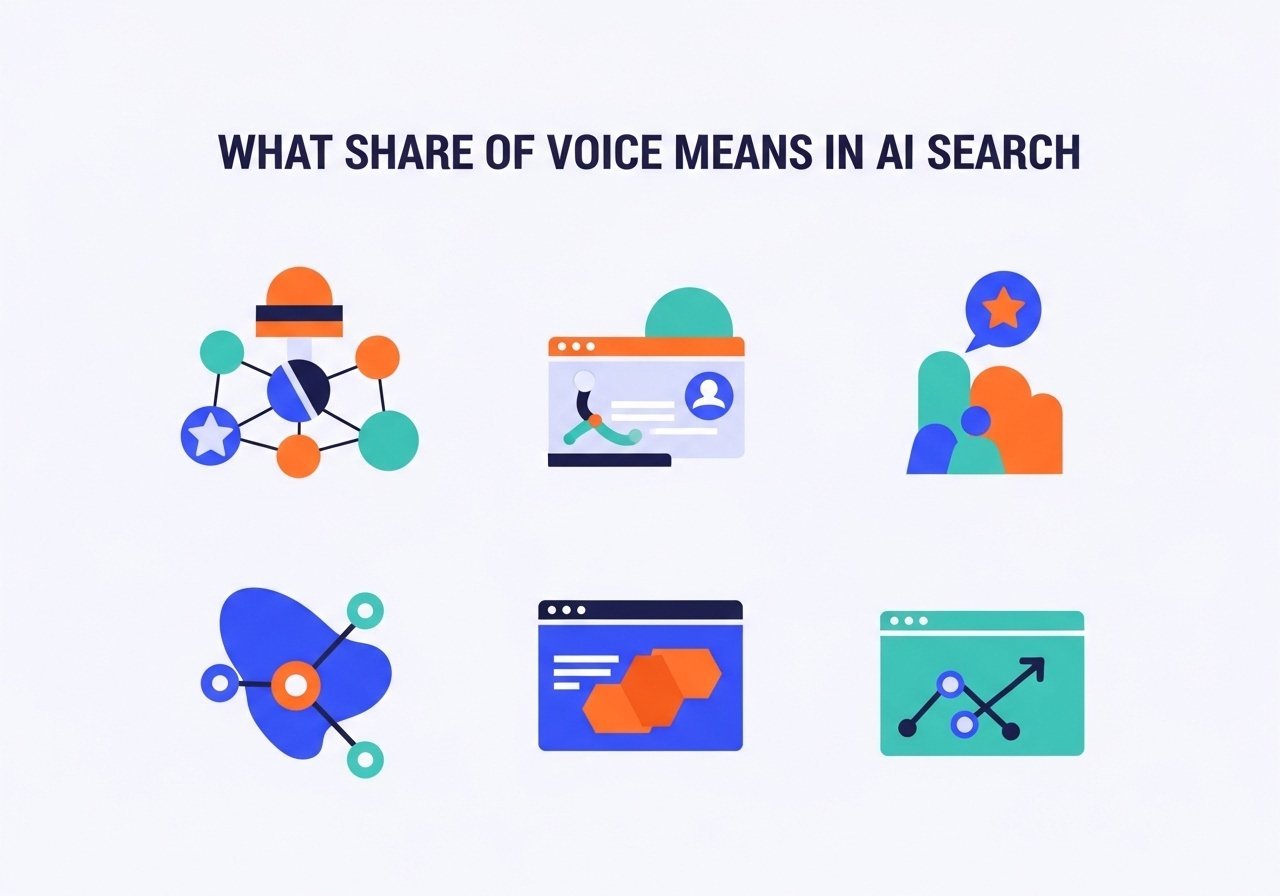
What Share of Voice Means in AI Search
When someone asks Perplexity “what are the best keyword research tools?” the response might mention Ahrefs, SEMrush, Google Keyword Planner, Ubersuggest, and Moz. Each of those brands has a share of voice in that response. If Ahrefs is mentioned first and discussed most thoroughly, it has the largest share.
Now multiply that across hundreds or thousands of relevant queries in your niche. The brand that consistently shows up across the most queries, in the most prominent positions, with the most favorable context, has the highest share of voice.
Share of voice in AI search is measured across several dimensions:
- Mention frequency: How often your brand appears across all relevant queries on a given AI platform
- Mention position: Where in the response your brand appears. Being mentioned first carries more weight than being listed fifth
- Mention context: How your brand is framed. Being recommended (“X is an excellent choice for beginners”) is stronger than being merely listed
- Citation type: Whether you get a clickable link (like on Perplexity) or just a text mention (like on ChatGPT)
- Platform coverage: Whether you appear across multiple AI platforms or just one
Why Share of Voice Is the Metric That Matters
Traditional traffic metrics do not fully capture the value of AI visibility. A brand that is consistently recommended by ChatGPT gets a trust advantage that does not show up in GA4 as a direct click. But it shows up in brand recognition, customer trust, and eventually in conversions.
Share of voice tells you something click-through rates cannot: how your brand is perceived by the AI systems that are increasingly mediating between you and your audience. If your share of voice is growing, your brand’s presence in AI conversations is strengthening. If it is shrinking, competitors are gaining ground.
This metric is especially valuable for:
- Comparing your AI visibility against specific competitors
- Identifying topic areas where you are strong versus where you have gaps
- Measuring the impact of your GEO optimizations over time
- Making strategic decisions about where to invest content resources
How to Measure Your Share of Voice
There are two approaches to measuring share of voice: manual audits and automated tools.
Manual Audit Method (Free)
This is the most accessible approach and works well for smaller sites or when you are just getting started with GEO measurement.
- Create a list of 20 to 30 queries that represent the topics your audience searches for. Pull these from your prompt-based keyword research
- Run each query on ChatGPT, Perplexity, and Google (with AI Overviews enabled)
- For each response, record: which brands are mentioned, in what order, with what context (recommended, listed, or cautioned against)
- Calculate your share by dividing your mentions by total brand mentions across all responses
- Repeat monthly to track changes over time
The limitation of manual audits is that AI responses can vary between sessions. Running each query 2 to 3 times helps account for this variability.
Automated Tool Method (Paid)
Several GEO tools now offer automated share of voice tracking:
- Semrush AI Visibility Toolkit: Monitors mentions and citations across major AI platforms with competitive benchmarking
- Scrunch: Tracks AI search performance with prompt-level analysis and share of voice metrics
- Profound: Provides citation analytics and competitive intelligence across AI engines
- HubSpot AI Search Grader: Free tool that evaluates how your brand appears in ChatGPT results with competitor comparison
These tools automate the query testing process, run queries at scale, and provide dashboards that show your share of voice trends over time. The paid options are worth considering once your GEO strategy is mature enough to benefit from detailed competitive data.
What Affects Your Share of Voice
Several factors influence how often and how prominently AI platforms mention your brand:
Topical authority: Sites that comprehensively cover a topic with interlinked content clusters are cited more consistently. AI platforms favor sources that demonstrate deep expertise.
Third-party mentions: The more your brand is mentioned across the web (on Reddit, in industry publications, on review platforms), the more AI systems associate you with your topic. This is the ChatGPT-specific authority signal that feeds training data.
Content quality and freshness: Well-structured, evidence-rich, recently updated content earns more citations than outdated or superficial material.
Original research: Unique data, surveys, and case studies give AI platforms something to cite that they cannot find elsewhere. This is one of the fastest ways to grow share of voice.
Brand consistency: Using a consistent brand name, messaging, and expertise positioning across all your online properties helps AI systems build a clear association between your brand and your topic area.
Growing Your Share of Voice Over Time
Share of voice in AI search compounds in a similar way to topical authority in traditional SEO. Each new piece of quality content, each brand mention earned, and each citation received strengthens the signals that AI platforms use to evaluate your brand.
The practical approach is straightforward:
- Measure your current share of voice across your key topics
- Identify the gaps where competitors are cited but you are not
- Create or improve content that directly addresses those gaps
- Build brand mentions on third-party platforms for topics where you are weak
- Track your share of voice monthly to measure progress
The brands that start measuring and optimizing for share of voice now are building an advantage that will be extremely difficult for late starters to overcome. AI citation authority, like domain authority, takes time to build but compounds powerfully once established.
Ready to create the kind of content that grows your share of voice? Our guide on writing for AI search covers the specific writing techniques that make your content citation-worthy across every AI platform.